From Digital Intelligence to the Real World: What Is Physical AI and How Will It Change Everything?
Discover Physical AI (Embodied AI), the breakthrough bridging digital intelligence with real-world movement. Learn how it works, key features, industry use cases, and future benefits.

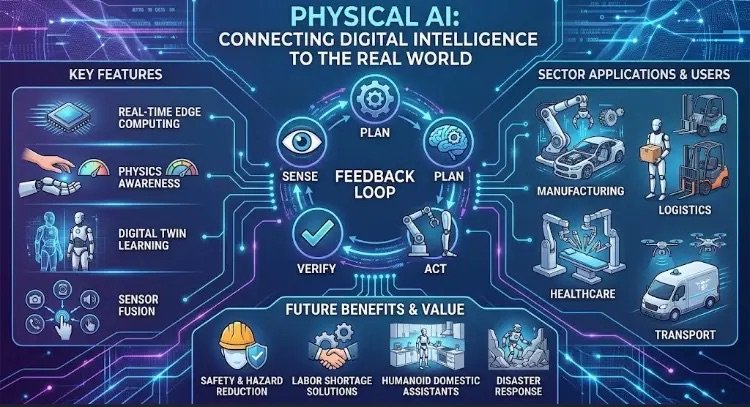
Physical AI infograph: Core features, real-world industry applications, and future value of embodied artificial intelligence.
When we think of artificial intelligence, most of us picture large language models chatting on our screens, text-to-image generators, or software analyzing datasets. However, AI is no longer confined to the pixels on a screen. We have entered a brand-new era where artificial intelligence perceives the physical world, handles physical objects, and directly interacts with the laws of physics—such as gravity, friction, and acceleration.
This revolution is known as Physical AI (or Embodied AI).
So, what exactly is this technology that bridges the gap between digital intelligence and real-world movement? How does it work, and how will it shape our daily lives in the future? Let’s explore it in detail.
1. What Is Physical AI?
Physical AI refers to systems that combine advanced perception (sensors), decision-making (software/models), and physical execution (robotic hardware and actuators) to operate within the real world.
Traditional artificial intelligence (such as an LLM or an image generator) takes digital data as input and produces digital data as output. Physical AI, on the other hand, receives input from the physical environment and produces an ACTION in the real world.
- A text-generating model: Says, “This box should be placed on the shelf to the right.”
- A Physical AI system: Detects the box using cameras and LiDAR, calculates its shape and weight, grasps it with a robotic arm, dynamically adjusts its grip if the object slips, and physically places it on the shelf.
The “Sense – Plan – Act – Verify” Loop
Physical AI operates through a continuous real-time feedback loop:
- Sense: Cameras, LiDAR, ultrasonic sensors, and tactile sensors scan the physical surroundings.
- Plan: The AI brain calculates the laws of physics, spatial dimensions, and obstacles to plan an action within milliseconds.
- Act: Hardware components (motors, gears, robotic limbs, wheels) execute the physical movement.
- Verify: The system instantly measures whether the outcome matched the intent and adjusts its next move accordingly.
2. Key Features of Physical AI
What separates Physical AI from traditional automation systems and standard software includes:
- Real-Time Edge Computing: Millisecond delays in the physical world can cause physical collisions or safety hazards. Therefore, decision-making occurs locally on onboard processors (Edge AI) without waiting for cloud latency.
- Physics Awareness & Adaptability: Standard factory robots merely repeat pre-programmed coordinates. Physical AI understands variables like object mass, surface friction, temperature, and center of gravity to adapt dynamically to novel environments.
- Learning via Synthetic Data & Digital Twins: Making mistakes in the real world is costly and hazardous. Physical AI models are trained millions of times inside high-fidelity digital twins (physics simulations) before deploying to real hardware.
- Multi-Sensor Fusion: It synthesizes visual streams, depth perception, acoustic data, pressure readings, and balance tracking simultaneously to construct a complete awareness of reality.
3. What Does Physical AI Do and Who Uses It?
Physical AI finds wide application across sectors that require physical labor, high precision, or hazardous operations:
🏭 1. Manufacturing and Industry
- Robotic Assembly Lines: Smart robotic arms that detect non-standard parts on an assembly line and adapt their gripping mechanics dynamically.
- Users: Automotive manufacturers, electronics makers, heavy industry enterprises.
📦 2. Logistics and Warehouse Operations
- Autonomous Warehouse Vehicles & Humanoids: Autonomous Guided Vehicles (AGVs/AMRs) navigating complex aisle topologies, along with humanoid robots picking and sorting packages.
- Users: E-commerce giants like Amazon, logistics networks, supply chain operators.
🏥 3. Healthcare and Medical Robotics
- Surgical Support Systems: Autonomous or semi-autonomous surgical robots (such as da Vinci platforms) that eliminate surgeon hand tremors and sense tissue resistance during delicate procedures.
- Users: Hospitals, surgeons, rehabilitation clinics.
🚜 4. Agriculture & Environment
- Smart Farming Equipment: Autonomous tractors and harvesting robots that judge fruit ripeness based on visual cues and tactile softness before picking.
- Users: Industrial farms, agritech startups.
🚗 5. Transportation and Autonomous Vehicles
- Self-Driving Vehicles & Delivery Drones: Vehicles that do more than lane-keeping—they anticipate weather dynamics, pedestrian behavior, and sudden obstacles in real time.
- Users: Autonomous vehicle developers, defense applications, logistics companies.
4. Benefits to Society and the Economy
The widespread adoption of Physical AI creates significant value for both enterprises and workforce safety:
- Occupational Health and Safety: Deploying AI-driven hardware in hazardous environments—such as mines, high-radiation zones, or toxic chemical processing plants—dramatically reduces workplace injuries.
- Addressing Labor Shortages: It directly addresses global shortages of skilled physical labor in sectors like logistics, warehousing, and manufacturing.
- Continuous Precision: Systems that do not suffer from fatigue maintain minimal error rates in assembly lines and material handling.
- Human Augmentation: The objective is not to replace human involvement entirely, but to hand off heavy, repetitive tasks to robots so workers can transition into strategic, supervisory, and creative roles.
5. Does Physical AI Promise Big Value for the Future?
Absolutely. The first wave of artificial intelligence centered around digital generation (Generative AI for text, code, and graphics). The second and largest wave of economic impact is widely expected to be Physical AI.
What Lies Ahead?
- Humanoid Domestic Assistants: Technologies refined today in industrial warehouses will eventually mature into domestic humanoid robots capable of cleaning, assisting elderly individuals, and taking over everyday household chores.
- Smart Cities & Infrastructure: Autonomous transportation networks and intelligent buildings will autonomously adjust to traffic congestion, weather events, and real-time accidents.
- Disaster Response & Search and Rescue: Physical AI robots capable of navigating unstable rubble, taking real-time structural decisions, and locating survivors during earthquakes or industrial fires will become standard response tools.
In Summary
Physical AI marks the transition of artificial intelligence from “thinking” to “acting.” This seamless integration of intelligent software and physical hardware will fundamentally reshape our interaction with the physical world over the coming decade.