What is an AI Factory? The Engine Shaping the Future of Business Models
Learn how the AI Factory model replaces traditional business hierarchies with a centralized data and machine learning engine to drive real-time, scalable growth and innovation.

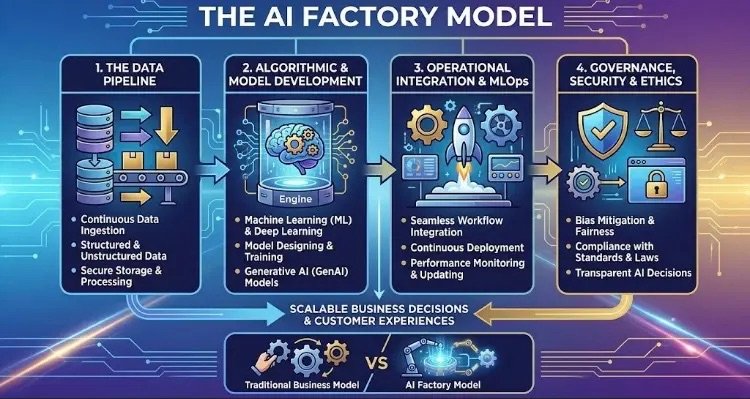
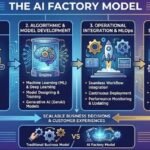
“The AI Factory Model: A breakdown of how modern organizations transition from legacy structures to centralized, data-driven engines. From the initial Data Pipeline and Algorithmic Development to MLOps integration and Governance, this framework transforms raw data into scalable business decisions.”
In today’s business landscape, the rules of competition are being rewritten at an unprecedented pace. Companies no longer win simply through physical assets or traditional software; their competitive edge lies in how effectively they turn raw data into intelligent, automated decisions. This shift has brought one of the most critical concepts of the modern digital economy to the forefront: the AI Factory.
Just as a traditional factory manufactures physical goods, an AI Factory operates as a continuous production line for artificial intelligence. Let’s explore what this transformative framework actually entails and why it matters.
1. What Exactly is an AI Factory?
An AI Factory is an operating model where an organization reshapes its core operations, decision-making, and customer experiences around a centralized data and AI engine, moving away from legacy, human-constrained hierarchies.
Popularized by Harvard Business School professors Marco Iansiti and Karim Lakhani, the concept defines a company that positions software and AI not merely as IT support tools, but as the primary engine of growth and value creation.
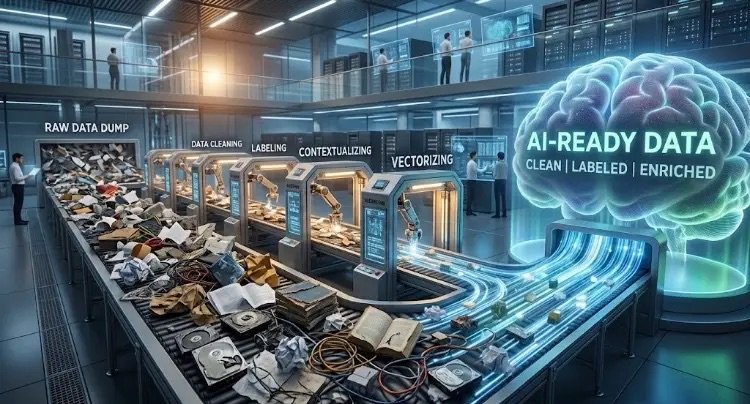
Much like an industrial plant takes raw materials and outputs finished goods, an AI Factory ingests raw data, processes it, trains machine learning models, and translates it into real-time, scalable business decisions and automated digital services.
2. Key Components of an AI Factory
Building and operating a successful AI Factory relies on four interconnected pillars:
- The Data Pipeline: Just as a physical factory needs a steady supply of raw materials, an AI Factory depends on continuous, clean, and structured data. Data ingestion, storage, and processing form the foundation of this workflow.
- Algorithmic & Model Development (The Engine): The R&D hub where machine learning, deep learning, and generative AI (GenAI) models are designed, trained, and iteratively refined.
- Operational Integration & MLOps: The deployment layer that seamlessly integrates trained models into daily operations, software applications, and decision-making workflows.
- Governance, Security & Ethics: The guardrails that ensure AI models remain unbiased, secure, transparent, and fully compliant with legal and ethical standards.
3. Traditional Business Model vs. AI Factory
While traditional businesses rely heavily on human labor and linear scaling, the AI Factory model focuses on digital speed and exponential scalability. FeatureTraditional Business ModelAI Factory Model Growth CapacityConstrained by headcount and physical infrastructure.Digitally scalable with near-zero marginal cost for additional volume. Decision-MakingRelies on human intuition and periodic reporting.Driven by real-time data analytics and automated AI insights. Learning CycleSlow, reactive feedback loops.Continuous learning and self-optimization via real-time data streams. Customer ExperienceStandardized and broadly segmented.Hyper-personalized and delivered dynamically in real time.
4. Key Advantages of the AI Factory Transformation
Transitioning to an AI Factory model grants organizations a strategic advantage that extends far beyond technical upgrade:
- Uncapped Scalability: Traditional scaling increases operational costs alongside output; an AI Factory scales digitally without proportional cost increases.
- Rapid, Error-Free Decision-Making: Processes millions of data points per second, eliminating human error and latency in routine decisions.
- Hyper-Personalization: Anticipates customer intent dynamically, tailoring product and service offerings to individual users instantly.
- Continuous Innovation: Feedback loops automatically refine system performance, enabling immediate adaptation to changing market conditions.
Conclusion
The AI Factory represents an inevitable evolutionary step in organizational architecture. While companies that treat AI as a peripheral novelty risk falling behind, those that re-architect their operations around a true AI Factory model will define the future of their industries.
Are you considering adopting an AI Factory approach within your own organization or projects, and if so, which phase do you anticipate being the most challenging—data readiness, infrastructure, or cultural shift?