The Code of Resurrection: What AI and Cloud Architecture Teach Us About Life After Death
Explore how artificial intelligence, cloud backups, and data architecture offer a fascinating digital model for the concept of resurrection and life after death.

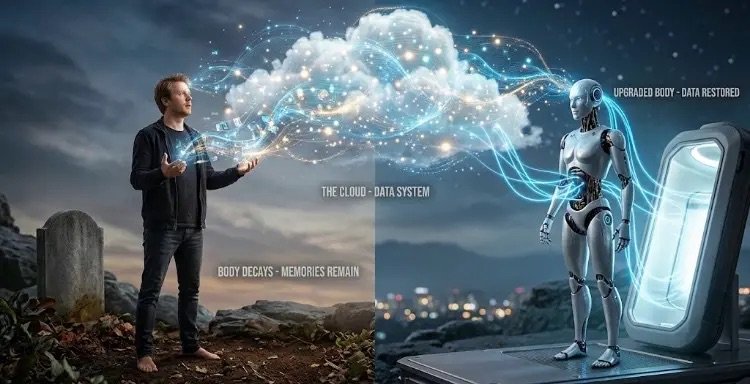
“From biological decay to the cosmic cloud: How technology models the eternal data of existence.”
One of the oldest questions in human history continues to echo through our minds: “Does everything end with death, or is there a continuation?”
Holy scriptures tell us that we will be resurrected after death, entering a new life where we will be held accountable for our actions, choices, sins, and good deeds. Yet, from a purely material or logical standpoint, that stubborn doubt always creeps in: Our bodies turn to soil, and our brains completely decay. Once that biological hardware containing our character, memories, and identity is gone, how will God evaluate us? With what memory and as what “version” of ourselves will we face that reckoning?
In the past, we tried to answer these questions solely through abstract philosophy, faith, or the limited imagination of earlier eras. But today, our world has completely changed. Why? Because through artificial intelligence, cloud systems, and big data technology, we have already built a living model of this very scenario with our own hands.
Artificial Intelligence, Cloud Backups, and the Reality of “Data”
We live in an era of AI models, smart systems, and cloud architecture. Let’s think about this concept in its simplest form using a humanoid robot and the artificial intelligence software driving it.
Suppose we send an advanced AI robot on a highly dangerous, high-risk mission. During the mission, a massive explosion occurs, and every piece of the robot’s physical hardware—its chassis, processor, and sensors—is completely melted and destroyed. From a traditional perspective, we would say, “That robot is finished, erased from history, gone forever.”
But in modern technology, that is not the case at all. All of the robot’s real-time data, learning algorithms, experiences, and weights are backed up to the cloud hundreds of times per second. Even though the robot’s physical body is completely shattered, that data set in the cloud remains safe and intact. What do we do next? We manufacture a brand-new robot body—perhaps a much more advanced version than the previous one—and deploy those cloud-stored data points into the new body.
What is the result? When the robot boots up, it might remember that catastrophic event as a memory, but its consciousness, identity, accumulated knowledge, and selfhood continue operating without missing a beat. It is just like when our phone breaks or our computer crashes—we load our backups onto a new device and pick up right where we left off, as if no interruption ever happened.
The AI Equivalent of Sacred Promises
This is precisely where the concept of resurrection after death described in holy texts finds a flawless mechanism in modern AI and cloud technology.
While ancient peoples imagined this as “being recreated from dust,” they were constrained by the mental models of their time. Today, however, we experience concepts like data recovery, cloud storage, model versioning, and synchronization every single day. When you view the human brain as a biological hard drive and our consciousness and memories as a unique data set saved to that drive, the logic of the afterlife becomes crystal clear.
Our bodies may complete their lifespan and decay. But the core “self” utilizing that body—the pure data of our soul—is never lost. God stores all our memories, choices, intentions, sins, and good deeds completely within His infinite system (that ultimate cosmic cloud).
The realm we call the afterlife is perhaps precisely that grand “reboot” moment, where this data is loaded into a vastly superior, flawless, and immortal new body (an upgraded version). When we open our eyes there, we will see—just like a user migrating to a new AI-powered device—that nothing was lost and our consciousness is fully intact.
Conclusion: The Truth Revealed by Technology
Artificial intelligence and digital systems do more than just give us tools to make our work easier; they offer us an incredible perspective on the operating mechanics of the universe and the logic of existence and the afterlife.
In the past, we simply had to believe blindly; today, thanks to technology, we can model it and make its logic concrete in our minds. The resurrection promised by God is, at its core, nothing less than the universe’s ultimate and most advanced data backup system.