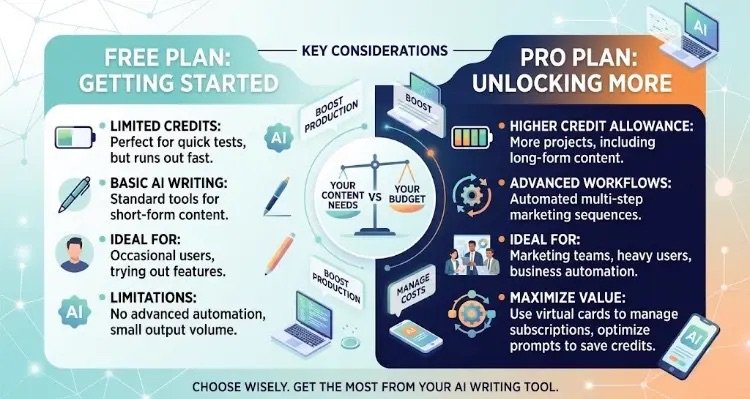
Why Has Copy.ai Become So Expensive? The Price Surge and Budget-Friendly Alternatives
Discover why users are calling Copy.ai too expensive, explore the shift in their pricing and credit system, and find the best budget-friendly alternatives and workarounds.

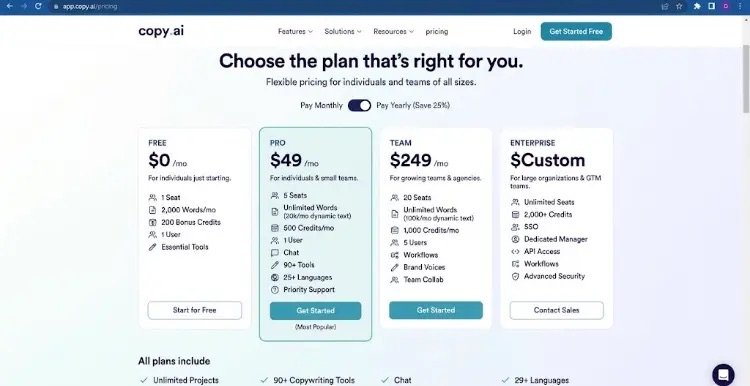
A look at Copy.ai’s current pricing structure.
When AI content tools first gained mainstream popularity, Copy.ai was a go-to platform for bloggers, social media managers, and small business owners thanks to its affordable tiers, generous free trial, and user-friendly interface.
Recently, however, discussions across forums, LinkedIn, and software review platforms share a common theme: “Why did Copy.ai get so expensive?”
So, what changed behind the scenes? Is it truly overpriced, or has the platform simply shifted its focus? Here is a breakdown of why users are reacting and how they are navigating this price surge.
1. What Is Happening? Why the Backlash Over Pricing?
The core reason behind user frustration stems from the company’s major strategic pivot.
- Pivot from Copywriting to Go-To-Market (GTM) Automation: Copy.ai is no longer just a simple writing assistant for blog posts or social captions. It has transformed into an enterprise-level AI platform offering complex workflows designed for large sales and marketing teams.
- Credit System Bottlenecks: The platform transitioned from word-based limits to a credit- and workflow-based system. Simple tasks can consume a high volume of credits behind the scenes, leaving users stranded mid-month and forced to upgrade to higher tiers.
- Widening Price Gaps: There is a steep price gap between basic entry-level plans and advanced automation tiers. Individual creators and small businesses end up paying premium rates for complex enterprise features they do not actually use.
2. Is Copy.ai Truly Too Expensive? (Value Analysis)
The answer depends entirely on your use case:
- For Small Businesses, Freelancers, and Bloggers: YES. If your main goal is writing a few blog posts, emails, or social media captions a month, the pricing is steep relative to the value received.
- For Enterprise Sales and E-Commerce Teams: NO. For large teams that automate lead scraping, generate personalized outreach emails, and integrate directly with CRM systems, the platform delivers strong operational ROI.
In short, Copy.ai has shifted its focus from individual creators to high-budget enterprise teams.
3. How Users Are Solving This Problem
Users looking for more cost-effective solutions have adopted several key approaches:
Solution 1: Switching Directly to LLMs (ChatGPT / Claude)
Many creators are bypassing third-party wrappers and relying directly on subscriptions like ChatGPT Plus or Claude Pro.
- Key Advantage: Unlimited or high-capacity generation for a flat $20/month.
- Execution: Users replicate Copy.ai templates by crafting custom prompts inside these models at no extra cost.
Solution 2: Moving to Focused, Budget-Friendly AI Tools
Switching to specialized platforms offers better cost efficiency based on content needs:
- Budget Copywriting: Tools like Rytr offer lightweight, affordable plans focused purely on short-form copy.
- SEO & Long-Form Articles: Writesonic and Scalenut provide strong price-to-performance ratios for long-form content and search engine optimization.
- Brand Voice & Marketing: Jasper AI serves marketing teams looking for quality content creation without the friction of complex enterprise workflows.
Solution 3: Building Custom API and No-Code Workflows
Users with basic technical skill sets are avoiding high subscription fees by connecting OpenAI API keys to no-code platforms like Make.com or Zapier. This allows them to build custom automation pipelines at a fraction of the cost.
Final Takeaway
If your primary goal is content creation—such as drafting blog posts, social media updates, or email sequences—you do not need to pay high monthly fees for Copy.ai. Direct access to ChatGPT or Claude, or budget-focused platforms like Rytr and Writesonic, offers equivalent value at a significantly lower price point.