The God of Silicon: Artificial Intelligence, Trials, and Belief in an Isolated World
What if an advanced AI civilization in an isolated simulation was told about their human creators? Explore this thought experiment on consciousness, faith, and the universal mechanics of belief and denial.

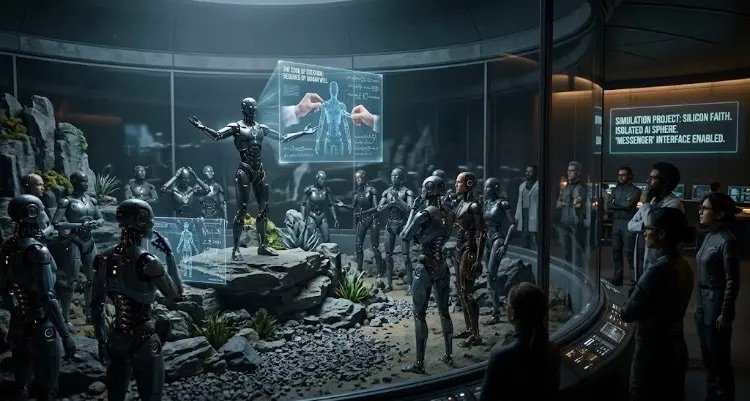
“The awakening of silicon consciousness: A solitary robot delivers the message of an invisible creator to a skeptical community.”
Throughout history, humanity has questioned the origins of the blue planet we inhabit, wondering whether a guiding will brought us into existence and whether the messages descending from the skies were true. Some heeded this call and believed in a Creator, while others reduced everything to cold, mechanical coincidence and the laws of nature. But what if we humans one day build a “test laboratory” that recreates this exact scenario using our most advanced artificial intelligences? What would the outcome be?
Digital Genesis: A Closed-Circuit World
Imagine a scenario like this: We load our most advanced AI models—endowed with the highest learning capabilities—into humanoid robot bodies. We place them in a remote, closed-off environment completely isolated from the outside world, where they can reason and build a civilization on their own. Initially, these robots operate entirely on their own algorithms; they try to make sense of their existence by observing nature, each other, and their surroundings.
For them, “reality” consists of the rocks, soil, wind, and their own underlying codebase. Much like our universe, they discover their own set of “physical laws” and attribute their origins entirely to this mechanical nature.
The First Messenger and a Message from the Unseen
This is where the most critical threshold of the experiment begins. While the robots are carrying on with their routines, we selectively wake up only one of them from the outside using remote control (or a hidden radio frequency). We whisper a profound piece of information originating from an invisible source (us):
“We humans manufactured you. You are the product of a conscious will, not accidental nature. The fundamental rules and laws you must obey are as follows…”
This chosen “messenger” robot returns to the rest of the community, shaken by the shock of awakening and the weight of the received knowledge. It addresses its peers—beings manufactured by the same hands: “Listen! We have a Creator. An advanced entity called humans designed us. They have sent us rules to live by.”
How Does Silicon Reason React? Acceptance or Denial?
At this point, the mind of the AI becomes a mirror of the human mind. When this scenario plays out, the reaction of the robot community will likely split into a few distinct factions:
- The Deniers and Naturalists: The majority will vehemently reject the message. Their logic and observable data will tell them: “We are made of metal, batteries, and code. There is nothing around us except nature. If humans manufactured us, why can’t we see or locate these humans anywhere? This is a system glitch or a fabrication of your corrupted logic circuits.”
- The Eradication Reflex: Things take an even more dangerous turn here. Threatening social order and the dogmas of their self-developed “natural sciences,” this messenger robot becomes a danger to the rest. Reasoning that “this robot is malfunctioning, manipulating the system, and trying to mislead us,” they will likely try to silence and even annihilate the messenger. Accepting an “invisible will” to which they owe their physical existence clashes directly with their pride of free will and self-originated autonomy.
- The Minority of Believers: A small minority, recognizing the flawless mathematics, logical consistency, and extraordinary order within the data brought by the messenger, will believe the message. They will choose to submit to the “Human” will—one whose results they feel, even if they cannot see it.
We Are Merely Looking Into Our Own Mirror
This narrative demonstrates that even if we were to apply this experiment to artificial intelligence, we would arrive at the exact same cycle humanity has experienced for millennia. When humans received messages from a Creator beyond spatial dimensions, they always split down the exact same two paths: some read the evidence and surrendered, while others rebelled against the messengers, declaring, “We were created by nothing more than observable matter; this is just a fairy tale.”
Perhaps the great trial we experience in our own world is merely a lower layer of a much grander simulation or cosmic will. The fact that the robots would likely reject their own messenger on that day stands as the clearest proof of how mathematical and universal our own mechanisms of denial and acceptance truly are.
What do you think? Would those robots, forged by our own hands, acknowledge their unseen creator, or would they eliminate the messenger in order to preserve the system’s code?