What is the Mixture of Experts (MoE) Architecture? The Next-Gen Efficiency Revolution in Large Language Models
Discover how the Mixture of Experts (MoE) architecture revolutionizes Large Language Models by activating only specialized sub-networks per token—boosting inference speed and model capacity while slashing compute costs.

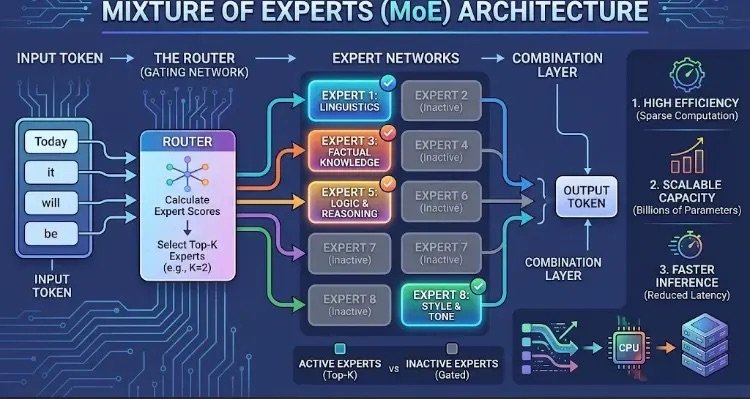
“A visual overview of the Mixture of Experts (MoE) architecture: A dynamic router directs incoming tokens to only the most relevant specialized expert sub-networks, enabling massive model capacity with high compute efficiency and faster inference.”
The world of Artificial Intelligence and Large Language Models (LLMs) is continuously evolving toward higher parameter counts and systems capable of tackling increasingly complex tasks. However, this massive scaling comes with a steep price: compute power, energy consumption, and inference latency.
In traditional dense models, every single parameter is activated simultaneously to process each word or token. As model sizes grow, this architecture drives hardware requirements and operational costs to astronomical levels. This is where the Mixture of Experts (MoE) architecture steps in—a groundbreaking approach rewriting the rules of efficiency and scalability in modern AI.
Understanding the Fundamentals of Mixture of Experts (MoE)
While the roots of MoE trace back to the 1990s, the concept has exploded in recent years by merging seamlessly with modern Transformer architectures. Its core philosophy is straightforward: “Instead of having everyone do every job, route each subtask to the specific sub-network that specializes in it.”
Rather than relying on a single monolithic neural network, an MoE-based model consists of multiple smaller, specialized sub-networks called “Experts” and a “Router” (or Gating Network) mechanism that dynamically matches incoming inputs with the right experts.
How Does the MoE Architecture Work?
To understand the mechanics behind MoE systems, it helps to break the architecture down into two primary components:
- The Router (Gating Network): Every incoming token (word piece) first passes through this layer. The router analyzes the token’s context and instantly calculates which “expert” networks are best equipped to handle that specific input.
- Expert Networks: These are independent Feed-Forward Network (FFN) blocks embedded within the model, each trained to focus on distinct linguistic structures, domains of knowledge, or contextual patterns.
Sparse Computation
The true magic of MoE lies in sparse computation. Instead of activating all experts in the model for an incoming query, the router typically uses a Top-2 or Top-K strategy to select only the most relevant experts.
For example, in an MoE layer consisting of 8 experts, each token is processed by only the 2 highest-scoring experts, while the remaining 6 remain completely inactive.
As a result, a model with 50 billion total parameters might operate by activating only 15 billion parameters per step. You gain the vast knowledge capacity of a massive model while retaining the speed and compute efficiency of a much smaller one.
Key Advantages of the MoE Architecture
- Massive Training Efficiency: MoE models reach the same quality benchmarks as dense models while requiring significantly fewer floating-point operations (FLOPs) during training.
- Faster Inference Speeds: Because only a fraction of the experts are active at any given moment, the processing time per token (latency) drops considerably.
- Immense Knowledge Capacity: By increasing the number of experts, developers can scale a model’s total parameter count—and its capacity to store factual knowledge—without proportionally multiplying compute costs.
Challenges and Limitations
Like any engineering paradigm, the MoE architecture introduces its own set of technical hurdles:
- The Load Balancing Problem: If the router network is poorly configured, traffic can repeatedly bottleneck into the same few “popular” experts. This leaves other experts underutilized while overloading a handful, degrading overall model efficiency.
- High Memory (VRAM) Requirements: Even though only a subset of parameters is active during computation, the weights of all expert networks must still reside in memory (RAM/VRAM). Consequently, running MoE models locally or in production demands high VRAM capacity.
- Training Instability: Training MoE models from scratch requires much finer hyperparameter tuning and more delicate optimization strategies compared to traditional dense architectures.
Prominent MoE Models Shaping the Industry
Many of today’s leading open-source and proprietary AI models rely on the MoE architecture under the hood:
- Mistral AI (Mixtral 8x7B and 8x22B): Trailblazing models that ignited the open-source MoE wave, featuring 8 experts per layer and activating 2 experts per token.
- DeepSeek (DeepSeek-V3 / R1): Models that have dramatically lowered training and inference costs while delivering frontier-level performance by combining advanced MoE routing with Multi-head Latent Attention (MLA).
- OpenAI GPT-4: Industry analyses and technical teardowns widely indicate that GPT-4 utilizes a massive MoE structure composed of 16 expert networks, each containing roughly 220 billion parameters.
The Mixture of Experts (MoE) architecture has dismantled the old AI rule of “running everything at once for more power,” ushering in an era of intelligent routing and selective focus. Its ability to scale model intelligence while keeping compute budgets in check makes it the backbone of both current and next-generation AI systems. For developers, researchers, and tech builders, mastering how MoE systems operate is essential for pushing the boundaries of modern AI deployment.