A New Era in AI: Why “Domain-Specific Small Language Models” (SLMs) Are the Talk of the Tech World
Discover why Domain-Specific Small Language Models (SLMs) are replacing massive cloud LLMs. Learn how specialized, lightweight AI cuts API costs, eliminates latency, and keeps enterprise data secure on-premise.

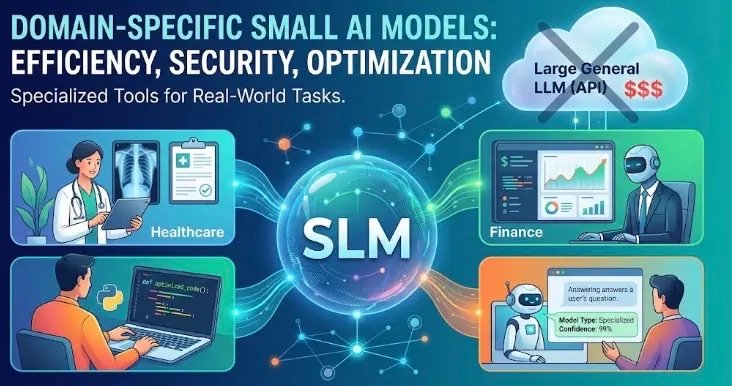
Domain-Specific Small AI Models: The power of specialized optimization. This graphic illustrates how localized SLMs outperform large general LLMs across key sectors like healthcare, finance, coding, and customer support.
For the past few years, the artificial intelligence landscape has been dominated by a race for sheer scale. Massive Large Language Models (LLMs) boasting trillions of parameters and trained on half the internet dictated the tech agenda. Recently, however, the winds have begun to shift. A new hero is quietly taking center stage—one that developers, entrepreneurs, and enterprises are flocking to in order to escape massive cloud API bills: Domain-Specific Small Language Models (SLMs).
So, what exactly are these small models everyone is talking about, and why are they suddenly shaking the throne of giant AI models? Let’s break down this quiet revolution.
Why Giant Models Aren’t Always the Answer
Using a massive, general-purpose cloud LLM for routine, straightforward tasks is like driving a Formula 1 car to the corner store to pick up a loaf of bread. The vehicle is undeniably powerful, yet completely overkill, sluggish for the specific errand, and outrageously expensive to run.
Companies and developers have increasingly hit three major walls with massive models:
- Token Bill Shock: For high-volume tasks like customer support bots or text classification, cloud API costs can quickly spiral into thousands of dollars per month.
- Latency Bottlenecks: Sending requests back and forth to external cloud servers slows down workflows in scenarios where milliseconds matter.
- Data Privacy Risks: Sending sensitive customer information, internal financial records, or confidential contracts to third-party APIs creates significant security and compliance vulnerabilities.
This is precisely where SLMs (Small Language Models) step in.
“Small” Yet Laser-Focused: What Exactly Is an SLM?
Typically ranging between 1 billion and 14 billion parameters, SLMs are lightweight enough to run comfortably on standard laptops, local servers, and even edge devices.
The secret sauce lies in their training: instead of trying to know “a little bit about everything,” these models are trained or fine-tuned to master one specific domain.
A Practical Analogy:
- Massive LLM (General Practitioner): Knows a broad range of medical concepts across every discipline, yet lacks the specialized precision to perform complex heart surgery.
- Domain-Specific SLM (Specialist Surgeon): Mastered strictly in cardiac surgery; it might not be able to explain quantum physics to you, but within its own specialty, it operates faster and with far greater accuracy than any generalist.
Why Are Companies Switching to Domain-Specific SLMs?
1. Near-Zero Variable Costs
While major APIs charge per token generated, running a 3B or 7B parameter model on your own hardware or local server costs little more than the electricity required to power the machine. The initial hardware setup pays for itself rapidly.
2. Data Security and On-Premise Execution
In heavily regulated industries like finance, law, and healthcare, sending data outside internal networks is often strictly prohibited. Because SLMs run entirely on-premise or locally on-device, the risk of external data leaks drops to zero.
3. Targeted, High-Precision Performance
Because general-purpose models juggle thousands of unrelated topics, they can occasionally hallucinate or misinterpret niche industry jargon and internal workflows. Conversely, a small model fine-tuned on a company’s historical support tickets or specialized industry documentation can easily outperform giant models within that narrow scope.
Popular Small Model Families Leading the Charge
Open-source tech giants are flexing their muscles in this space. Some of the most widely adopted small model families include:
- Microsoft Phi Series (e.g., Phi-3 / Phi-4): Trained heavily on “textbook-quality” synthetic and curated data, these models punch way above their weight class in reasoning and coding.
- Meta Llama Series (e.g., Llama 3.2 1B/3B): Lightweight powerhouses specifically optimized for mobile integrations and edge computing.
- Alibaba Qwen Series (e.g., Qwen 2.5): A developer favorite thanks to strong multilingual capabilities and versatile parameter sizes.
- Hugging Face SmolLM Series: Completely open, ultra-compact architectures engineered for maximum efficiency.
The Architecture of the Future: The “Hybrid Router” Model
The AI strategy of the future isn’t an “either/or” choice between small and large models. Instead, the industry is converging on an intelligent hybrid routing approach:
- Thousands of daily, repetitive, rule-based queries (e.g., “Where is my order?” or “What is your return policy?”) are routed directly to a local SLM and answered in milliseconds.
- Rare, multi-layered queries requiring deep reasoning or broad creative synthesis are escalated to massive cloud LLMs.
This smart routing mechanism protects the budget while maintaining top-tier performance across the board.
Final Thoughts
The era of “bigger is always better” is slowly coming to a close. In modern AI, the real competitive edge isn’t about running the largest model available—it’s about deploying the most efficient, focused, and intelligent small model tailored to the exact job at hand.
If you are looking to slash operational costs, boost response speeds, and keep your data safely under your own roof, now is the ideal time to bring domain-specific small models into your workflow.