How Much Can We Trust AI? The Price of Easy Knowledge on Critical Thinking
While artificial intelligence offers instant answers and boosts productivity, over-relying on it comes with a hidden cognitive cost. Discover how "cognitive offloading" weakens our critical thinking muscles—and learn practical habits to keep your analytical mind sharp in the age of AI.

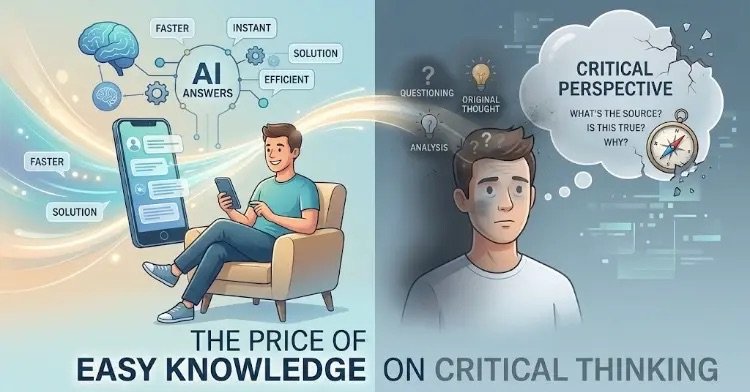
A conceptual illustration comparing the instant gratification of AI-driven answers with the long-term mental fatigue and erosion of deep analytical abilities, suggesting that relying solely on “easy knowledge” weakens critical perspective.
Today, finding an answer to a question, understanding a complex topic, or generating an idea from scratch is much faster than ever before. The fluent, polished, and persuasive texts that appear before us in seconds greatly speed up our lives. However, this convenience carries an invisible and steadily deepening price: Cognitive laziness and the silent erosion of critical perspectives.
Recent research reveals that the excessive and unchecked use of artificial intelligence tools weakens the human brain’s capacity to question, analyze, and generate original interpretations. So, does asking AI everything make us smarter, or does it trap us in a digital echo chamber by weakening our own cognitive muscles?
1. The Cognitive Cost of Ready Answers: “Cognitive Offloading”
By nature, the human brain is programmed to conserve energy. When faced with a difficult math problem, two conflicting arguments, or deep data analysis, our minds resist. When AI instantly breaks this resistance by handing us a “ready-made result,” the brain rewards this shortcut.
This is known as cognitive offloading. Rather than memorizing information, minimizing mental effort with the mindset of “it’s already on the internet” or “I’ll just ask AI” leads to long-term consequences such as:
- Loss of Deep Reading and Focus: The ability to patiently examine long texts and catch nuances between the lines withers away.
- Memory Weakening: Because attention focuses directly on the outcome rather than remembering the paths to reach the source of information, permanent learning fails to take place.
2. The Loss of Inquiry: Blindly Trusting the First Response
When conducting research on traditional search engines, users browse multiple sources, spot contradictions, compare different perspectives, and form their own synthesis. This process was a challenging yet nourishing exercise that unknowingly worked out critical thinking muscles.
AI models, on the other hand, usually provide a single, clear, and highly confident response. Users tend to accept this response without question because:
- Time constraints drive people toward the most direct outcome. 2 Since the language produced by AI is extremely fluent and professional, the margin of error is easily overlooked (hallucinations and biases become unquestionable).
As a consequence, questions like “Is this information actually correct?”, “What assumption is the author relying on here?”, and “What is the other side of the coin?” begin to echo less and less in our minds.
3. Algorithmic Uniformity and the End of Original Interpretation
AI models are trained on specific datasets and generate statistically most “probable” responses that reflect average human tendencies. When every individual receives similar responses with similar prompts from the same AI tool, thoughts begin to standardize over time.
Generating an original idea feeds on contradictions, errors, intuitions, and the blend of individual life experiences. AI, however, offers a smoothed-out, dulled, and risk-free “middle ground.” Individuals who become dependent on this face the danger of losing their own original voices and creative interpretive capabilities.
4. What Can We Do Against This Danger? (A Conscious Usage Guide)
Completely removing AI from our lives is neither realistic nor correct; it is a powerful lever, an assistant. However, to prevent this assistant from becoming our master, we must develop certain conscious habits:
- Adopt a Socratic Approach: Instead of asking AI for a direct result, ask it to guide you. Rather than saying, “Explain topic X to me,” actively participate in the process by saying, “What hypotheses should I examine to understand topic X?”
- Cross-Verify: Always double-check the information provided by AI using different sources and raw data.
- Never Drop the “Why” Question: Before accepting an argument, run the filter in your mind: “What data supports this result? What alternative explanations could there be?”
- Do Not Avoid Mental Struggle: Sometimes the best learning happens in moments when we stumble and exert mental effort. Preserve the habit of racking your brains instead of turning to AI at every difficulty.
Conclusion
Technology offers us the most powerful tools in history to understand the world. However, when these tools start thinking on our behalf, we face the risk of losing the most fundamental virtue of being human—inquiry and critical perspective.
Artificial intelligence can be a compass, but who holds the helm always depends on our own willpower. Remember; accessing information may become easier, but the responsibility of understanding and interpreting always rests with humans.