The Era of Trust in AI: Ending Hallucinations with RAG 2.0
Learn how RAG 2.0 tackles AI hallucinations by combining real-time retrieval engines with Knowledge Graphs to deliver enterprise-grade, verifiable accurate results.

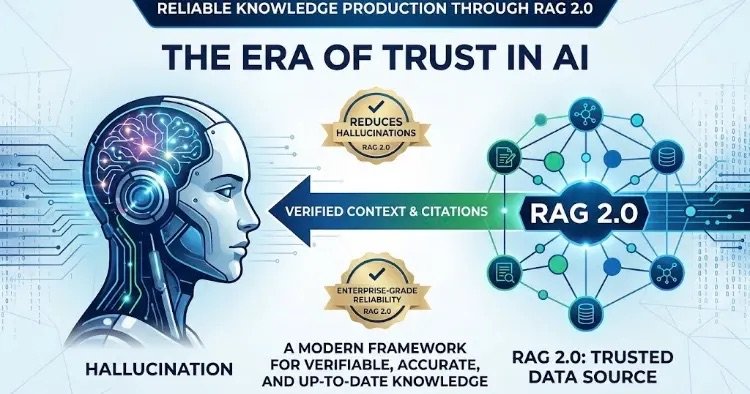
“Visualizing RAG 2.0: How retrieval-augmented generation bridges the gap between AI models and reliable, up-to-date data structures.”
Artificial intelligence tools have seamlessly integrated into our daily workflows. We frequently rely on large language models (LLMs) to draft content, summarize lengthy reports, and answer complex technical questions in seconds. However, this convenience brings a critical challenge: How do we ensure the accuracy of the generated information?
This brings us to one of the biggest bottlenecks in AI adoption: hallucinations—instances where AI models generate false, inaccurate, or fabricated information with absolute confidence. To solve this fundamental flaw, the tech ecosystem has evolved beyond early retrieval systems to RAG 2.0 (Retrieval-Augmented Generation 2.0).
What is RAG 2.0 and How Does It Work?
First-generation RAG architectures introduced the concept of grounding LLM responses in external, domain-specific databases. While revolutionary, RAG 1.0 often struggled with context retrieval accuracy, complex document structures, and fragmented data outputs.
RAG 2.0 refines and optimizes this process through a unified ecosystem:
- Query Intelligence: Advanced query expansion and intent analysis break down complex user prompts into actionable search vector parameters.
- Hybrid Retrieval Engines: Combines semantic (vector-based) search with traditional keyword search (such as BM25) to ensure deep context comprehension.
- Knowledge Graphs & Re-Ranking: Leverages structural relationships between data points and applies re-ranking algorithms to filter out noise, delivering only the most precise, contextual fragments directly to the model.
In short, RAG 2.0 enforces a strict operational framework: Do not guess; retrieve verifiable context from trusted sources and synthesize the answer directly from them.
Why Does Verifiable Knowledge Matter?
In a data-saturated market, fast access to information is no longer enough—verified accuracy is essential. In critical sectors like finance, healthcare, legal compliance, and enterprise operations, a single AI hallucination can lead to severe financial losses or regulatory penalties.
Key operational advantages of RAG 2.0 include:
- Full Traceability (Source Citation): RAG 2.0 systems anchor generated text to specific internal documents, policy PDFs, or database rows, offering complete transparency.
- Real-Time Data Integration: Retraining LLMs from scratch can take months and incur massive costs. RAG 2.0 allows enterprise data to be updated dynamically, giving models immediate access to real-time information.
- Minimized Hallucinations: Constraining generative outputs to verified external knowledge layers significantly lowers error rates.
The Business and Economic Impact
For enterprises evaluating AI implementation, Return on Investment (ROI) is paramount. Continually fine-tuning or training proprietary base models requires immense compute power and financial expenditure.
RAG 2.0 provides a far more cost-effective alternative. By decoupling the reasoning engine (the LLM) from the knowledge repository (the vector storage and graph engines), organizations can update their knowledge bases instantly without re-training underlying models. This minimizes compute overhead, streamlines operations, and mitigates risks associated with inaccurate AI outputs.
The Bottom Line: Moving Toward Enterprise-Grade AI
RAG 2.0 shifts generative AI from a creative text generator into an enterprise-ready knowledge assistant. It protects corporate memory, improves operational speed, and ensures data transparency.
The future of enterprise AI will not simply belong to the models that contain the most parameters, but to the architectures that cite the most reliable sources. RAG 2.0 sets the baseline for that trustworthy future.