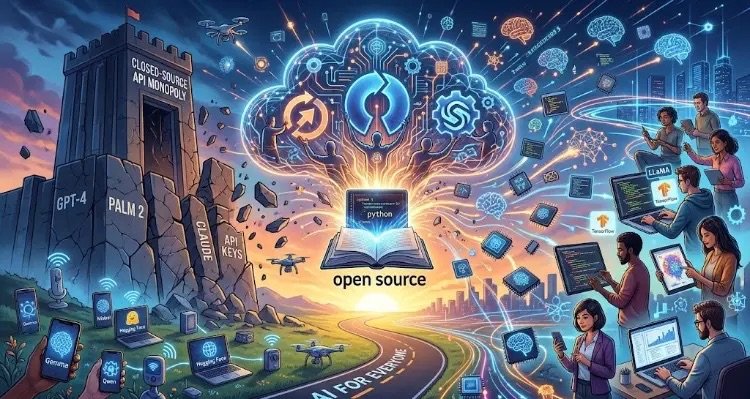
Open-Source vs. Closed-Source AI: A Detailed Comparison of Cost, Performance, and Privacy
An in-depth comparison between open-source AI and closed-source APIs. Explore how DeepSeek, LLaMA, and Qwen stack up against OpenAI and Anthropic in terms of cost, performance, and data privacy.

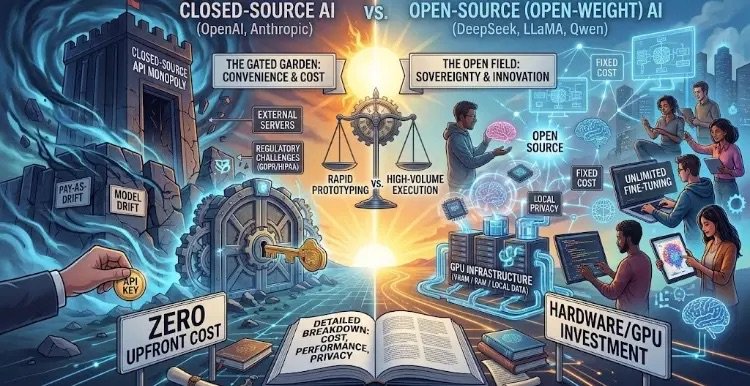
“A side-by-side conceptual illustration comparing closed-source AI and open-source AI, highlighting key differences in cost models, architecture, data privacy, and hardware investment.”
As artificial intelligence rapidly evolves, companies, developers, and content creators face a critical strategic choice: Should you rely on closed-source API services like OpenAI and Anthropic, or leverage open-source (open-weight) models such as DeepSeek, LLaMA, and Qwen?
Here is a comprehensive breakdown comparing both approaches across cost structure, system performance, and data privacy.
1. Cost Structure: Pay-As-You-Go vs. Hardware Investment
Closed-Source APIs (OpenAI, Anthropic, Google) These services operate on a pay-as-you-go model based on token consumption or monthly tier subscriptions. The primary advantage is zero upfront capital expenditure, as you do not need expensive GPU infrastructure or specialized hardware investments. However, as your prompt volume and production scale increase, monthly API bills grow exponentially, creating a substantial operating expense. For high-traffic applications, scaling costs can become exceptionally steep.
Open-Source Models (DeepSeek, Meta LLaMA, Qwen) These models run either on-premise on your own hardware or through dedicated cloud GPU instances. Once your infrastructure is established, your marginal costs remain fixed regardless of how many tokens you generate, granting unlimited query capacity. The trade-off is that deploying mid-to-large models—such as 32B or 70B parameter variants—requires high VRAM capacity GPUs or ongoing cloud server rentals, demanding an initial investment and technical setup.
2. Performance and Customization Flexibility
Closed-Source APIs Proprietary models deliver top-tier general reasoning, advanced multimodal capabilities, and instant access to vast knowledge bases out of the box. Their plug-and-play nature makes integration effortless. However, you have no access to the underlying architecture. When the service provider updates or deprecates a model, your system outputs can suffer from unexpected shifts, commonly referred to as model drift.
Open-Source Models Open-weight architectures provide complete freedom for fine-tuning. By training the model on your proprietary dataset, you can achieve superior domain-specific performance for a niche industry or brand voice compared to generic closed APIs. The main challenge lies in the engineering effort: matching the general knowledge and edge-case reasoning of the largest closed models requires thoughtful hardware optimization and data curation.
3. Data Privacy, Security, and Compliance
Closed-Source APIs Using cloud APIs requires sending your prompts and context over the internet to third-party servers. Unless you sign specialized enterprise agreements, you must continuously monitor vendor terms regarding whether your data is logged or used to train future iterations. For organizations handling sensitive financial, medical, or legal data, meeting strict regulatory frameworks like GDPR or HIPAA can prove challenging due to external data transmission.
Open-Source Models Open-source models can be deployed entirely offline in air-gapped environments or local corporate networks. Your data never leaves your local hardware or private cloud, providing absolute data sovereignty. This ensures that internal confidential documents, customer records, and trade secrets remain 100% secure, simplifying compliance with strict data protection mandates.
Summary Comparison
When evaluating initial costs, closed-source APIs require zero upfront investment, whereas open-source solutions demand hardware or GPU server setup. In terms of scaling, closed-source costs compound as query volume increases, while open-source infrastructure maintains predictable, fixed operational costs.
Regarding privacy and control, closed-source models route data through external vendors, whereas open-source systems grant 100% local privacy and complete ownership over model weights. Finally, while closed-source platforms offer easy setup via simple API keys, open-source deployments offer unlimited fine-tuning flexibility at the cost of requiring technical setup and ongoing maintenance.
Which One Should You Choose?
Opt for Closed-Source APIs if your goal is to build rapid prototypes, handle low-to-moderate query volumes, or instantly leverage cutting-edge general reasoning without managing infrastructure.
Opt for Open-Source Models if you operate at high query volumes, process sensitive or regulated data, require air-gapped execution, or plan to build a highly specialized expert model trained on your proprietary data.