Forget Prompt Engineering: Context Engineering is the Invisible OS of AI
Prompt engineering is no longer enough. Discover how Context Engineering is transforming AI applications by building intelligent system architectures, dynamic memory layers, and context-driven data pipelines.

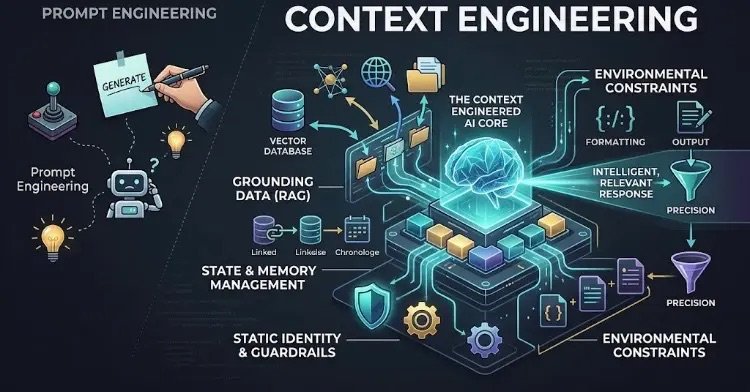
Context Engineering Overview: A conceptual breakdown showing how dynamic memory, RAG data, system guardrails, and environmental constraints feed into an AI core compared to traditional prompt engineering.
During the first wave of the AI revolution, we all rushed to become “Prompt Engineers.” We memorized magic phrases, carefully stacked adjectives, and tried to decipher the exact wording needed to nudge Large Language Models (LLMs) into giving us the perfect output. But the technology evolved rapidly, and the rules of the game shifted. Today, the real magic isn’t in what you tell a model in the moment—it’s about what the model already knows, what it forgets, and how intelligently its surrounding digital workspace is designed before it generates a single word.
Enter Context Engineering.
While standard internet guides focus on superficial tips like “be polite” or “assign a role,” let’s look under the hood at the actual mechanics of constructing an AI’s cognitive environment.
1. Prompting vs. Context Engineering: The Core Distinction
- Prompt Engineering: An instantaneous instruction given to a model in real time. Think of it like throwing a single punch in a boxing match—it dictates a single, immediate action. It is transient and isolated.
- Context Engineering: The architectural design of the entire ecosystem in which the model operates. It is the arena, the physics, the referee, and the cumulative fight history loaded into memory.
LLMs are stateless by nature—they lack persistent memory between isolated calls. Within a given context window, every generated token depends entirely on the boundary parameters provided to it. Context Engineering is the art and science of curating dynamic data flows, system instructions, behavioral boundaries, and external integration layers (like RAG) into a unified framework.
2. Anatomy of a Context Layer
A well-architected context layer is far more than a block of system instructions. It is built in structured, functional layers:
- Static Identity & Guardrails: The core instructions defining the persona, domain limits, tone, and non-negotiable safety or technical constraints.
- State & Memory Management: User preferences, relevant conversation history, and dynamic state tracking that allow the model to tailor responses without forcing the user to start from scratch each time.
- Grounding Data (Retrieval-Augmented Generation): Real-time, external information retrieved dynamically from databases, vector stores, or search tools to ensure facts remain fresh and accurate rather than reliant solely on training weights.
- Environmental Constraints: Strict structural rules governing output formats (JSON, Markdown, schema validation), target audience constraints, and conciseness parameters.
3. The Fatal Flaw: Context Pollution
A widespread myth in AI application design is that more context always yields a smarter response.
In practice, the opposite is frequently true. Just as a human struggles to focus when inundated with irrelevant noise, LLMs suffer from context pollution when overloaded with bloated, redundant, or contradictory inputs. Dumping excessive data into a context window leads to predictable failure modes:
- “Lost in the Middle” Effect: Attention mechanisms struggle to prioritize crucial directives when they are buried inside massive blocks of passive text.
- Increased Latency & Cost: Unnecessary tokens consume processing power, driving up API costs and inflating response times.
- Elevated Hallucination Risk: Conflicting or ambiguous context forces the model to resolve discrepancies on its own, increasing the likelihood of fabricated details.
An elite context engineer doesn’t give the model everything—they give it the precise, minimal set of high-signal information required for the specific task at hand.
The Shift in AI Architecture
Prompting is an end-user skill; Context Engineering is a systems architecture discipline.
As AI integrations deepen across enterprise platforms, competitive advantage will no longer belong to those who write clever prompts, but to those who construct intelligent, clean, and dynamic context pipelines around the model.