The Open-Source AI Explosion: Is the Throne of Closed-Source Models Shaking?
The AI landscape is shifting rapidly as open-source models challenge closed API monopolies. Discover how open-weight AI is reclaiming data privacy, lowering costs, and democratizing technology for developers and creators.

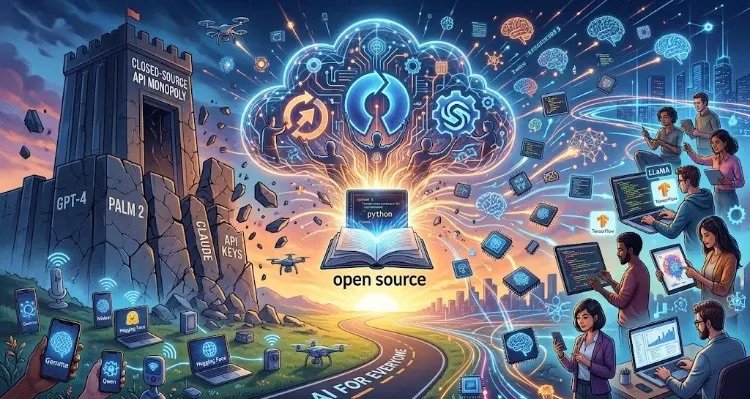
“A dynamic landscape showing the open source AI explosion, where a towering ‘Closed-Source API Monopoly’ fortress featuring GPT-4 and Claude is being bypassed by a glowing ‘AI for Everyone’ path. In the foreground, people use open source models like LLaMA and Hugging Face on laptops and phones, symbolizing accessibility and innovation.”
The AI revolution of recent years left us largely dependent on closed-source API services—cloud-based solutions controlled by tech giants like OpenAI, Anthropic, and Google. But the tide is turning with unprecedented speed. Today, the Open-Source (Open-Weight) AI Explosion is reclaiming control from tech monopolies, placing power back into the hands of developers, small businesses, and independent creators.
Why is this boom happening now, and why should readers, content creators, and business owners care? Let’s take a closer look at this wave of AI democratization.
1. Why Now? What Made Open-Source Models So Powerful?
In the past, open-source AI models lagged far behind their closed API counterparts—capable of basic text generation, but failing at complex reasoning or coding benchmarks. Today, the landscape has shifted completely:
- Performance Convergence: Data from MIT Sloan and independent evaluation platforms (like Artificial Analysis) show that the new generation of open-weight models captures over 90% of closed systems’ performance. In certain areas—especially cost-efficiency and customizability—they hold a clear lead.
- Mixture of Experts (MoE) Architecture: By deploying smart architectures that activate only a fraction of their total parameters (e.g., 32B active parameters out of hundreds of billions) per request, these models offer massive knowledge bases while keeping inference costs remarkably low.
- Massive Enterprise Backing: Commitments worth billions of dollars from industry pillars like Red Hat and IBM have accelerated innovation across the open-source ecosystem to record levels.
2. Next-Gen Open-Source Contenders Disrupting the Market
“Open source” no longer means small experimental tools. Heavyweights capable of shifting global balances are taking center stage:
- DeepSeek & Qwen Series (Alibaba): Models developed by Asia-based research labs are giving closed-source rivals serious competition with their native multimodal capabilities, ultra-long context windows (up to 256K), and superior mathematical reasoning.
- Meta (LLaMA Series): Serving as the backbone of the open-source ecosystem, the LLaMA family gives developers an infinite playground for community-driven fine-tuning.
- Google Gemma: Google’s research prowess packaged into lightweight models optimized to run on local hardware has ushered in the era of Edge AI.
3. What It Means for Readers and Digital Publishers
This explosion isn’t just a technical detail for software engineers; it directly impacts digital content creation and the broader internet landscape:
- Data Privacy & Air-Gapped Systems: Companies and content creators no longer need to route sensitive data through third-party servers. Using tools like Ollama or LM Studio, you can run AI models locally on your own machine—completely offline, with zero risk of data leaks.
- Zero API Costs & Independence: Escalating monthly subscription fees and token-based pricing are no longer a burden for small agencies and solo entrepreneurs. Hosting an open-source model on your own hardware unlocks unlimited production without rate limits.
- Real-Time Customization (Fine-Tuning): Instead of relying on a generic AI, you can train a tailored model directly on your own article archives, brand voice, or private databases.
Retaking Control
Closed-source AI models may have ignited the first big spark, but the open-source wave empowers creators and builders to take back control of the web. AI is no longer just a service rented from corporate tech giants—it has become a public canvas that anyone can run, refine, and shape on their own servers.
From website backends to content automation pipelines, the next era of the web will be built on open-source intelligence.