Next-Gen AI in Autonomous Vehicles: The Brain Behind the Self-Driving Revolution
"Discover how next-generation AI—featuring end-to-end learning, multimodal fusion, and generative simulation—is transforming autonomous vehicles and redefining human mobility."

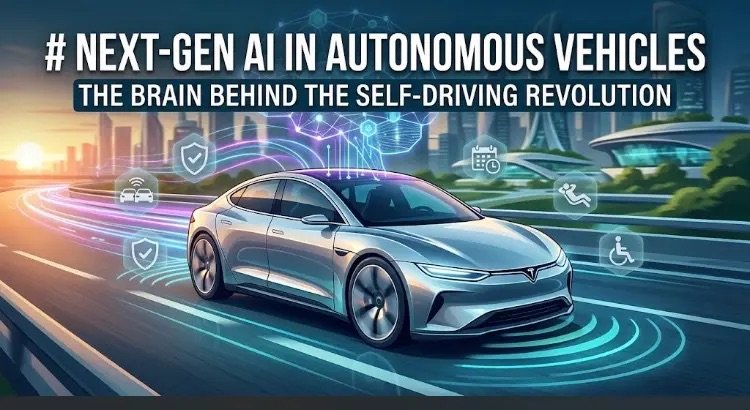
An illustration of a silver autonomous car driving on a futuristic highway, featuring a dynamic digital visualization of integrated AI systems, safety shields, and efficiency symbols, with the title: ‘# Next-Gen AI in Autonomous Vehicles: The Brain Behind the Self-Driving Revolution’.
The automotive industry is in the middle of its most dramatic transformation since the assembly line. Self-driving cars—once the domain of sci-fi—have gradually transitioned onto our roads. However, first-generation autonomous systems quickly ran into wall: they struggled in heavy rain, choked on unpredictable human behavior, and faltered in complex urban chaos.
Enter Next-Generation AI. Driven by Generative AI, Multimodal Learning, and End-to-End Deep Learning, this new wave of intelligence is taking over the steering wheel. But what actually changes when next-gen AI takes control, and more importantly, how does it make human life better?
Why Early Self-Driving Systems Hit a Wall
First-generation autonomous vehicles relied heavily on rigid, rule-based software. Think of them like students who memorized a textbook cover-to-cover:
- “If you see a crosswalk, stop.”
- “If you drift out of the lane, correct.”
The flaw? Real-world driving isn’t a textbook. It’s filled with unpredictable “edge cases”—a skateboarder suddenly darting out from behind a parked truck, a blinding snowstorm obscuring lane lines, or a driver making an indecisive left turn. When faced with these gray areas, early systems often froze, disengaged unexpectedly, or slammed on the brakes without cause.
What Makes Next-Gen AI Different?
Rather than following a rigid decision tree, next-gen AI mimics how the human brain actually learns and adapts.
1. End-to-End Deep Learning
Instead of splitting tasks into separate pipelines (sensing, mapping, path planning, acting), next-gen AI uses massive neural networks that map raw sensor data directly to control commands (steering, braking, accelerating). The car doesn’t just read code—it intuits scenarios like a seasoned driver.
2. Multimodal AI Fusion
Modern autonomous systems don’t rely on cameras alone. They synthesize inputs from LiDAR, radar, acoustic sensors, and Vehicle-to-Everything (V2X) communication simultaneously. If a fog bank blinds the optical camera, LiDAR steps in. The AI cross-references all feeds in milliseconds to construct a crystal-clear picture of its environment.
3. Generative AI Simulation
A major hurdle for autonomous cars is gaining experience with rare, dangerous hazards. Next-gen Generative AI generates millions of synthetic accident scenarios, extreme weather conditions, and bizarre road obstacles in virtual space, training the vehicle before it ever touches real asphalt.
The Human Impact: Why This Tech Matters to You
Beyond the impressive engineering, how does this shift actually improve daily life?
1. A Dramatic Drop in Traffic Accidents
Over 90% of traffic collisions are caused by human error—distraction, fatigue, speeding, or impaired driving. Next-gen AI doesn’t get tired, angry, or check a text message. With reaction times measured in milliseconds, it has the potential to prevent millions of crashes and save countless lives globally.
2. Reclaimed Time and Greater Efficiency
Think about the hours lost sitting in traffic or stressing over parallel parking. Fully autonomous vehicles turn commute time into productive work hours, relaxing downtime, or family catch-ups. Plus, AI-driven acceleration and route planning lower fuel and battery consumption, trimming your carbon footprint.
3. Freedom of Mobility for Everyone
Next-gen autonomous vehicles redefine independence for the elderly, individuals with visual or physical disabilities, and those without a driver’s license. Point-to-point transportation becomes universally accessible.
4. The End of Phantom Traffic Jams
When vehicles communicate directly with each other (V2V) and sync their speeds, “phantom traffic jams”—those annoying slowdowns caused by one driver tapping their brakes—disappear entirely, keeping city traffic flowing smoothly.
Looking Ahead: The Road to Hands-Free Living
Next-generation AI elevates autonomous vehicles from an experimental tech demo to a dependable, life-enhancing utility. In the near future, owning a car may yield to requesting a fully autonomous vehicle on demand—letting you step in, sit back, and enjoy the ride.
A world with stress-free commutes, safer roads, and cities designed for people instead of parking lots is no longer a distant promise—it’s actively being coded right now.