Digital Books of Deeds: Artificial Intelligence, Mass Surveillance, and the Illusion of Playing God
"Discover the striking parallel between ancient divine surveillance and modern AI mass surveillance. Explore how digital panopticons, algorithmic scoring, and power intoxication risk leading governments to play God in the digital era."

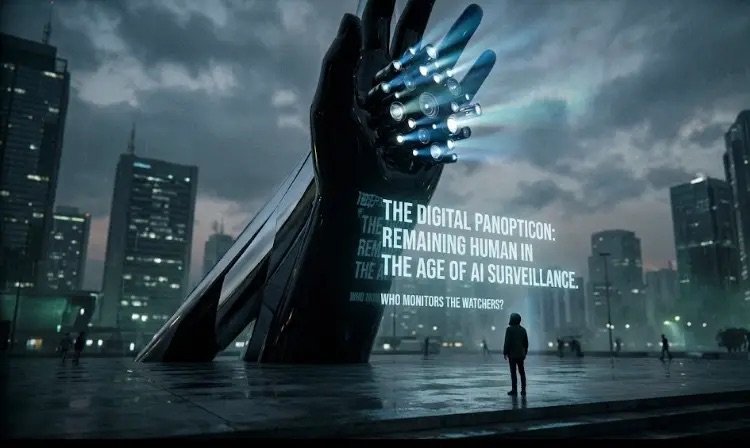
“A futuristic monument to surveillance: A massive, lens-studded hand rises from a city square, symbolizing the all-seeing presence of AI. Does it offer protection, or does it enforce a digital panopticon that calls into question our very humanity?”
Throughout human history, one of the cornerstones of morality and social order has been the belief in an unseen yet all-seeing higher authority. In theological teachings, the world is a testing ground where every human action, intention, and behavior is continuously recorded. When the day of judgment arrives, these undeniable records will be laid bare, leaving no room for objection, and every deed will have its score. A perfect divine evaluation system where individuals cannot deny their own actions…
Yet in the 21st century, we are witnessing a striking counterpart to this millennia-old concept of divine surveillance within the digital realm. Only this time, the onlooker is not a divine power, but algorithms, cameras, and artificial intelligence.
From Divine Surveillance to the Digital Panopticon
Today, mass surveillance systems deployed across various parts of the world are routinely packaged under the guise of “security,” “crime prevention,” or “social order.” Powered by facial recognition, audio monitoring, digital footprint tracking, and social credit systems, individuals are constantly watched, measured, and rated.
The intimate space that humans once shared with their conscience or the Divine is now being reshaped through the lenses of AI-powered cameras and the cold servers of data centers. Every step is documented and transformed into indisputable digital evidence—much like a modern “book of deeds.”
Power Intoxication and the “Playing God” Illusion
This brings us to the most critical hazard demanding our attention: power intoxication.
Although states and entities controlling these surveillance technologies claim to act in the interest of security, absolute monitoring power possesses an inherent capacity to corrupt human nature. Managing a system that sees everyone, records everything, and decides who is “virtuous” or “guilty” through algorithmic scoring creates a dangerous illusion for those holding the reigns.
Historically, the ultimate trap for those who attain unchecked power has been mistaking themselves for divine authorities. Could the unprecedented control afforded by artificial intelligence fuel an appetite for total dominance, leading ruler elites to act as if they are modern-day deities?
Conclusion: Remaining Human in the Digital Era
In the divine framework, oversight is deeply tied to justice, mercy, and a test undertaken through free will. Conversely, AI-driven surveillance in the hands of earthly powers risks becoming a mechanical instrument of dominance—devoid of mercy, demanding absolute compliance, and reducing human beings to mere data points.
Artificial intelligence can undoubtedly simplify our lives and enhance security. However, if we allow those who govern these technologies to succumb to power intoxication and attempt to “play God,” we risk forfeiting our freedom and humanity in the name of safety. Ultimately, the vital question is not merely how algorithms monitor us, but how we will monitor the hands behind those algorithms.