From Science Fiction to Reality: Where Do Humanoid Robots Stand Today and How Will They Change the World?
Explore the current state of humanoid robots, their rapid shift from labs to factory floors, and the profound physical, economic, and societal benefits they bring to humanity.

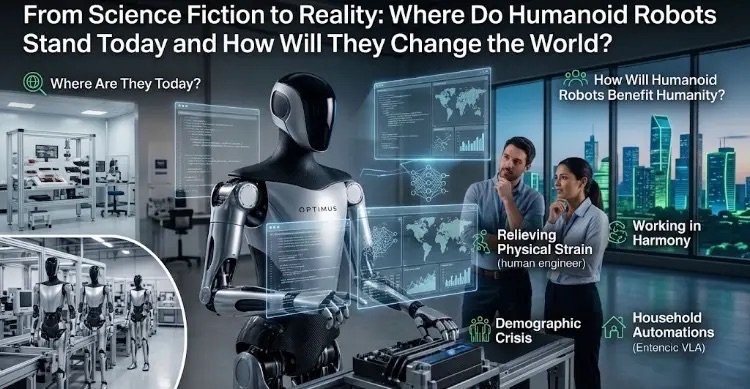
“An overview of the current state and future impact of humanoid robots, illustrating factory deployments, technological integration, and societal benefits.”
For decades, humanoid robots lived only in movie theaters, sci-fi novels, and the minds of visionaries. For most of us, they were either rebellious cinematic villains or a distant fantasy of the far future. However, the tech landscape is evolving so rapidly that the line between science fiction and reality has completely blurred.
Today, humanoid robots have stepped off exhibition stands and into the core of global industry. But where does the market stand right now? How is the transition from research labs to factory floors taking shape, and most importantly, what benefits will these engineering and AI marvels actually bring to our daily lives?
1. Where Are They Today? The Transition from Labs to Factory Floors
In the past, robotics referred almost exclusively to heavy, stationary industrial arms designed for specific repetitive tasks, such as spot welding car bodies. Today, the conversation has shifted toward general-purpose humanoid robots—machines that walk on two legs, maintain dynamic balance, handle delicate objects with articulate fingers, and perceive their surroundings using advanced artificial intelligence.
Industry metrics signal a major tipping point: global shipments of humanoid robots are accelerating dramatically as industrial integration takes off. Key developments driving this ecosystem forward include:
- Real-World Factory Deployments: Automakers and tech firms are actively integrating humanoids into operations. Tesla continues to test and refine its Optimus models within its own manufacturing facilities, while Figure AI deploys platforms in BMW production plants. Apptronik is running pilot programs with Mercedes-Benz and NASA, testing how models like Apollo perform in logistics and assembly settings.
- Capital and Start-up Momentum: Venture funding is flowing into both hardware manufacturing and software intelligence. China-based developers (such as Unitree, AgiBot, and Robotera) are scaling cost-optimized platforms, while US-based companies lead in cognitive AI integrations and foundational robotic models.
- The Convergence of Hardware and AI: Walking is no longer the primary hurdle; spatial intelligence and adaptable manipulation are. Powered by Vision-Language-Action (VLA) models and large language models (LLMs), humanoids can translate natural language commands directly into physical actions, learn from visual demonstrations, and adapt to unpredictable environments on the fly.
2. How Will Humanoid Robots Benefit Humanity?
The value humanoid robots bring extends far beyond mere economic productivity gains. They offer structural solutions to some of humanity’s most persistent physical and demographic challenges.
Relieving Physical Strain and Improving Workplace Safety
Millions of people perform physically taxing or high-risk jobs daily—carrying heavy crates in logistics hubs, working high-altitude construction, or carrying out repetitive assembly line tasks. Humanoid robots are built to operate within environments originally designed for human ergonomics: climbing stairs, utilizing standard hand tools, and maneuvering through tight spaces. By taking over hazardous, exhausting, and repetitive labor, robots allow human workers to shift toward creative, supervisory, and strategic roles.
Mitigating Demographic Crises and Aging Populations
Many nations face accelerating demographic shifts characterized by aging populations and shrinking active workforces. As the ratio of retirees to working-age adults increases, eldercare demands are outstripping supply. Humanoid assistants offer a scalable way to support home care, assist individuals with mobility challenges, track medication schedules, and provide interactive companionship to improve quality of life.
Automating Household Chores
Tasks like unloading the dishwasher, folding laundry, vacuuming, and organizing living spaces consume a significant portion of personal time. Much like the introduction of the automatic washing machine redefined household labor in the 20th century, general-purpose household humanoids have the potential to automate everyday domestic chores entirely.
Emergency Response and Disaster Relief
When natural or industrial disasters occur—such as earthquakes, nuclear leaks, structural collapses, or severe fires—first responders face life-threatening conditions. Humanoid robots equipped with human-like mobility can navigate rubble, operate valves, and search hazardous zones where conventional wheeled or tracked vehicles cannot go, rescuing survivors without risking human life.
3. Looking Ahead: What Does the Future Hold?
Humanoid robots are no longer an abstract concept; they represent one of the defining technological shifts of the coming decade. As hardware costs decline and embodied AI becomes more capable in physical environments, the presence of humanoid assistants in factories, hospitals, and homes will become increasingly routine.
The central question is no longer “Will humanoid robots arrive?” but rather “How quickly will societies adapt to their integration?” Combining human agility with artificial intelligence, these systems are poised to become one of the most powerful tools for human progress.