The Convergence of AI and Robotics: How Intelligent Machines Are Reshaping Our Physical World
Discover how integrating artificial intelligence with advanced robotics transforms mechanical hardware into adaptive, learning machines. Explore real-world applications across smart manufacturing, healthcare, precision agriculture, and what lies ahead for humanoid technology.

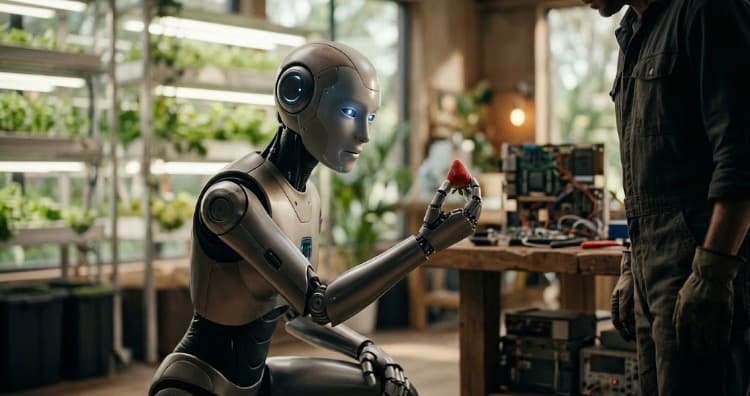
“An advanced humanoid robot gently examines a freshly picked strawberry alongside a human worker, blending cutting-edge artificial intelligence with precision agriculture.”
The intersection of Artificial Intelligence (AI) and Robotics represents one of the most exciting and transformative technological leaps of our time. Traditionally, industrial robots were purely mechanical machines following static, pre-programmed instructions—such as repeating the exact same welding movement on an assembly line.
By embedding AI into these physical frames, we give them a “brain.” Modern robots are no longer just automated; they can see, hear, make real-time decisions, adapt to environmental changes, and most importantly, learn from experience.
1. What Is AI + Robotics Integration and How Does It Work?
At its core, this integration fuses AI software algorithms (machine learning, deep learning, computer vision) directly with robotic hardware (sensors, actuators, mechanical limbs, mobile chassis).
Here is how the system operates in real time:
- Sensors (Vision & Perception): AI-powered robots scan their physical environment using cameras, LiDAR, and depth sensors. Computer vision allows them to recognize objects, identify humans, and map spatial contours in real time.
- The AI Brain (Processing & Reasoning): Deep neural networks process raw sensory data in milliseconds. The robot answers critical operational questions instantly: “What object is in front of me?”, “What is the safest path forward?”, or “How much force should I apply to lift this delicate item without breaking it?”
- Actuators (Execution & Movement): Once a decision is made, the robot’s motors and grippers execute physical actions with adaptive precision—whether harvesting fragile crops or lifting heavy machinery.
2. Real-World Applications Across Industries
This powerful synergy has moved far beyond science fiction, driving core operations across key global industries:
- Smart Manufacturing & Industry 4.0: Traditional isolated industrial robots are giving way to Cobots (Collaborative Robots) that work safely alongside human operators, adapting instantly to changes on the production line.
- Autonomous Logistics & Warehousing: Autonomous Mobile Robots (AMRs) navigate complex warehouse floors, optimize picking routes, avoid dynamic obstacles, and streamline supply chains.
- Precision Healthcare & Surgery: Surgical robotic systems enable doctors to perform minimally invasive procedures with sub-millimeter precision, while autonomous hospital robots transport medications and manage inventory.
- Precision Agriculture: AI-driven farming robots identify weeds to apply targeted treatment, monitor crop health, and harvest produce at peak maturity.
- Exploration & High-Risk Missions: Robots equipped with advanced AI handle dangerous environments—such as deep-sea exploration, nuclear inspection, and disaster search-and-rescue—keeping humans out of harm’s way.
3. Key Advantages of AI-Driven Robotics
- Continuous 24/7 Precision: Unaffected by fatigue or distraction, AI-integrated robots maintain ultra-low error rates and maximum operational yield.
- Real-Time Adaptability: Unlike rigid legacy systems, AI robots handle unpredictable events—like a misplaced package or altered workflow—without human intervention.
- Enhanced Workplace Safety: Delegating hazardous tasks in heavy industry or chemical processing drastically reduces occupational injuries.
- Continuous Learning via Data: Cloud-connected robotics constantly gather operational insights, updating their software models over time to become faster and more efficient.
4. Future Outlook: What Lies Ahead?
The fusion of AI and physical hardware will fundamentally reshape society over the coming decades:
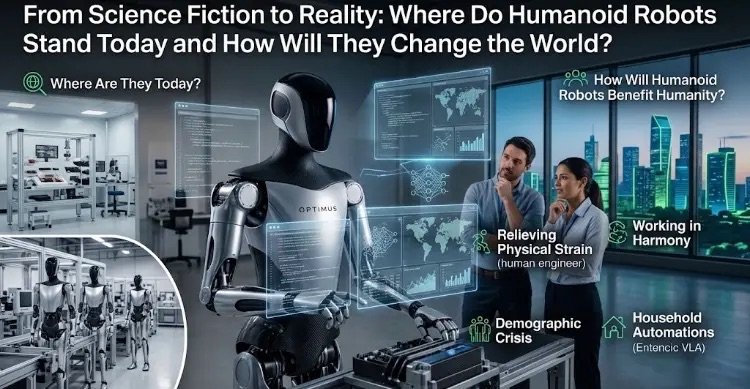
- Humanoid Robots in Daily Life: Companies like Boston Dynamics, Tesla (Optimus), and Figure are building bipedal humanoids designed to assist with household labor, eldercare, and complex physical maintenance.
- Swarm Robotics: Large fleets of smaller robots will communicate through central AI networks, coordinating like biological swarms for large-scale construction, environmental cleanup, or emergency response.
- Physical Artificial General Intelligence (AGI): As AI models evolve beyond text and image synthesis, they are learning to reason directly within physical 3D space, mastering complex manipulation and spatial logic.
- Shift in the Workforce: As repetitive manual labor automates, human roles will increasingly pivot toward high-value creative strategy, system oversight, and technical engineering.
Key Takeaway: The marriage of AI and robotics transitions machines from passive tools into active, adaptive partners. By expanding intelligence from the digital realm into physical reality, smart robotics is laying the groundwork for a safer, more productive future.