Why AI Trading Bots Still Fail: The Psychology Behind Stock Market Chaos
Discover why artificial intelligence, despite its flawless memory and zero emotions, still shares a similar success rate with human traders in the unpredictable stock market.

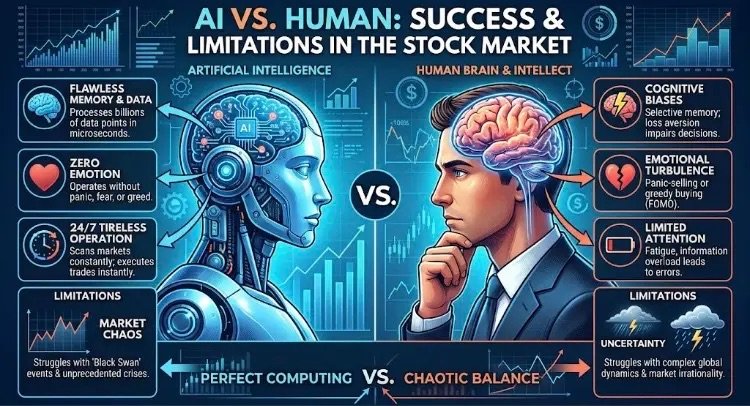
AI vs. Human Trading: Flawless computing meets market chaos and human psychology.
It is an open secret in the financial world: even seasoned investors, backed by advanced degrees and years of market experience, frequently fail at stock trading. Behavioral finance experts usually pin this down to human psychology. Emotional impulses, lack of focus, and selective memory often push traders into costly mistakes.
This raises a fascinating question: If emotions and memory lapses are what ruin human traders, why hasn’t Artificial Intelligence completely taken over the stock market?
AI possesses flawless memory, processes massive datasets in microseconds, and remains utterly immune to panic or greed. Yet, its performance often lands shockingly close to human averages.
Here is why emotionless precision doesn’t automatically equal stock market dominance.
The Human Flaw: Why Smart Investors Make Dumb Trades
Trading requires making cold, rational decisions under intense pressure—something human evolution simply did not prepare us for. The average trader usually stumbles over three psychological hurdles:
- Emotional Volatility: Panic-selling during a dip or buying at all-time highs due to Fear Of Missing Out (FOMO) are purely emotional reactions.
- Selective Memory: Traders tend to remember their big wins while mentally blocking out their losses, making it hard to learn from past mistakes.
- Cognitive Overload: No human brain can monitor earnings reports, macroeconomic shifts, and global news feeds simultaneously without fatigue.
The AI Edge: The Ultimate Rational Trader
On paper, AI seems like the ultimate stock trader. Algorithms offer distinct advantages that bypass human limitations:
- Zero Emotion: AI never trades out of revenge, fear, or overconfidence.
- Total Recall: It remembers every market crash, financial indicator, and historical pattern instantly.
- Constant Speed: It operates 24/7, executing complex trading strategies in milliseconds.
Given these superpowers, one would expect AI to outperform the market effortlessly. But in reality, it runs into a structural brick wall.
Why Emotions Aren’t the Only Thing Breaking the Market
The reason AI doesn’t win every trade isn’t a flaw in coding—it is a reflection of how financial markets actually work.
1. Overfitting to the Past
AI algorithms are trained on historical data. However, the market is constantly evolving. When unprecedented events or “Black Swan” crises hit, historical patterns break down. An AI relying strictly on past data can become utterly blind to a completely new reality.
2. The Market is Fueled by Human Irrationality
Stock prices aren’t driven solely by balance sheets and math; they are driven by collective human behavior. Because markets are influenced by crowd psychology, fear, and hype, an AI acting completely rationally will often be outmaneuvered by the irrational actions of millions of human participants.
3. The Paradox of Market Impact
When an AI discovers a highly profitable strategy and starts deploying massive capital, its very actions alter market dynamics. The profitable loophole vanishes simply because the AI tried to exploit it at scale.
Final Thoughts: Human Weakness vs. Market Chaos
Humans fail at trading because of internal limitations—emotions, bias, and burnout. AI struggles because of external reality—the chaotic, fluid, and inherently unpredictable nature of financial markets.
Trading isn’t just a math problem waiting to be solved by raw computing power; it is a complex social ecosystem. Until markets stop being influenced by human unpredictability, even the most sophisticated, emotionless algorithms will continue to share the same battlefield—and similar odds—with human traders.